Showing posts with label modeling. Show all posts

23 May 2017

SCW tanks, part 2

Well now, a line has been drawn in the sand...  Over at his fine blog  20mm and then some, Gunbird has declared a month of kit building, aiming for a kit a day until June 21.  And, I wandered into his trap!  Now, getting 30 kits done in a month seems to be out of reach for me, but it is a nice dose of impetus to finally get myself into gear after the recent slump.

Right off the bat, I worked on that first 1/72 Minairons FT-17 that was half-finished so long ago:


Here it is now, with some weathering and track detail.  The tracks are not yet finished, with some more rust to be added.  The weathering was an experiment using Golden High-Flow acrylics.  The paints are just fine, but I mixed them with an airbrush extender that was glossy (and sticky even after more than 24 hrs).  I expect that the little guy will look much better after some dull coat.

One last test fit:


It is not quite finished - the exhaust needs some work, and I want to add some slogans to the hull or turret.  Those should have been painted on before weathering (decals also), but it is a learning curve and it will be all right in the end.


And moving along:


Two more FT-17's have been started.  Actual time for completion - might be some time as I have some ideas that I want to try with the turrets, but the hull will make progress.


.

21 September 2016

SCW Republicans, part 6

With a little bit of work, the crew of the MMG was changed around a bit.

First off, this pic shows the pieces of the 1/72 WW2 Russian gun crews from Plastic Soldier:


There are 8 figures per frame (two figures per frame are split into two pieces each), and a variety of heads and weapons are included.  One or both arms on a select few figures are also separate pieces.  The gun crew pack from Plastic Soldier has 4 of these frames in it, which gives a lot of pieces for potential conversions!

(I want to thank Arjun again for his generosity in sending me these figures  - see this post.)


Here is what I started with for the MMG stand:


The original crew from Minairons is pewter, with the plastic gunner replacement in plastic.  I chose to use a Czech-style helmet for the new gunner.  The base is a 1¼" diameter steel fender washer, with a sticky dot to cover up the hole.

At this point, I decided that the original leader would be better off with my Nationalist forces, so a replacement is needed.  The old gunner would be perfect with a slight change - replace the right hand with a plastic one that is pointing out a target in the distance:


And, a couple of cuts later:


Add a bit of glue (super glue for the plastic-to-metal connection):


Simples.


The new gunner needed a bit of attention as well:


In the pic above, one can just see the entrenching tool attached to his belt.  I trimmed off the handle, and will paint the rest to look like a normal belt pouch.


I used a small drill bit to make a hole for the new head - plastic is so easy to drill!


And, some test-fitting of the crew:


It will be a tight squeeze to get all of the crew on the base - the loader is positioned at an angle to the weapon, which takes up more room.  I am fairly certain that the new gunner is not firing the MMG in the textbook manner, but it should be OK.  One note - the Plastic Soldier figures seem to be a bit more broad in the shoulders than the figures from Minairons, but it should blend in seamlessly once the crew is painted and based.

The dark spot in the above pic is also part of the base - While trying to get the original gunner to fit more closely to the weapon, I trimmed the base to a point where the figure will not stand upright on its own.  Hence, a nice rock for the new leader to rest his knee upon...


.

11 May 2016

15mm pikes

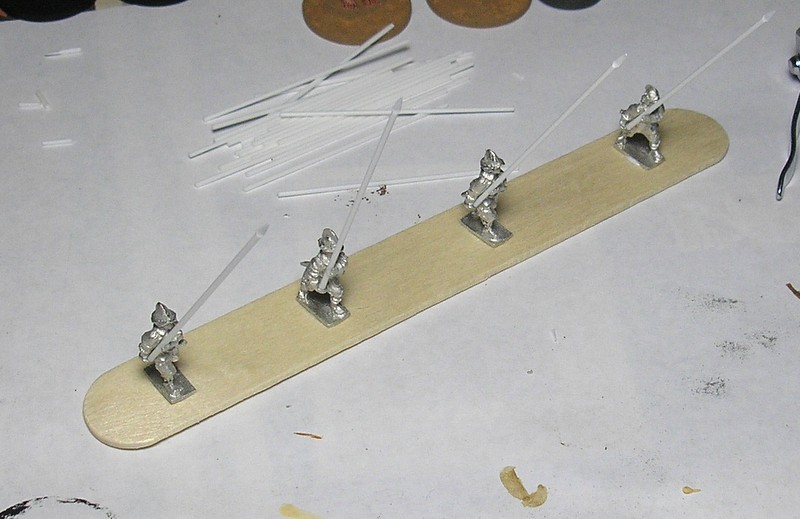
As the Testudo 30YW pikemen did not come with pikes, I had to find a supply of weapons for the figures.  So, I turned to an old method of mine, by using plastic rod for the pikes.

Way back on this post on my blog, one can see how I used the same technique to make the spears for my Tékumel figures (and some of those pics are better!)

First off, some raw material:


This package dates back to sometime in 1999...


And, some processing:


The rod is cut into 50mm lengths by just rolling the edge of the knife blade on it, then snapping the rod at the cut.


After a few minutes of cutting:


Next, the business end of the pike takes shape.  I place one end of the rod into some pliers with a flat tip, and give it a good squeeze, and then trim the flattened part to make a point.


This poor pic shows the three stages:


The point is approximately 2mm in length.  Very simple, very easy.


With a bit of super-glue, the troops have a new weapon:


The 1mm diameter rod fits in very well.  Now, to prime and paint...


.

09 April 2016

Boschenburg musketeers, part 4

There are times when I look back on a project and ask myself, 'What was I thinking?'

Well, I know what I was thinking when I mounted my Half Continent troops on ¾" washers - smaller footprint for the figures is good, and I can just make my own sabot bases.  That did not turn out as planned, so I am re-basing them onto 25mm MDF:


Here is the carnage so far.  Fortunately, no major damage has been done to the figures!  But, I have many more to go before the task is finished.

Luckily, many of the monsters were put onto 25mm bases at the start, and the grinnlings will keep their ¾" bases as I do not foresee them being grouped for mass battle...

WW1 German ships, part 2

With a little bit of spare time, I was able to make a little more progress with my WTJ 1/1800 ships. 


Magdeburg and Strassburg, and their masts.  I am not certain of the diameter of the brass rod used for the masts, but the yards are made of 0.006" brass wire (the long piece in the pic above).  Again, the mounting holes for the masts are printed into the WTJ cruisers, so just a bit of glue and in they go.


It is a different story with the TB's.  Their masts are also made from the thin brass wire, but I had to use a drill bit to make a hole for them.  I did not put yards on the masts for the TB's.


All of my 1/1800 ships now have their masts, although it is a bit hard to see from that angle.  Primer will make it much easier to see - more pics after that!

02 April 2016

WW1 Russian ships, part 3

Inspiration can strike suddenly, and this time I took advantage of the situation and worked on my WTJ ships a bit.


Here is my small flotilla of 1/1800 ships - German cruisers on the left, Russians on the right.  One can see that I have already primed the first Russian cruiser - Bogatyr - but I forgot one small detail... masts!  So, back to work.


I have some thin brass wire that I use for masts, and this time I decided to use plastic rod as well.


Before putting in the masts, I looked around for some pictures to
help guide the work.  The WTJ ships have holes for masts already present
in the model, in cruisers and larger at least, so siting the masts was
not a problem, and I found a pair of pictures in one of my books - The Imperial Russian Navy by A.J. Watts - showing differences between Bogatyr and Oleg
The book shows that Oleg has a slightly different bridge structure,
without searchlight wings, and the masts are slightly different also.


In the pics below, one can just barely see the trimmed bridgework on Oleg, the rightmost cruiser.


Bogatyr from the bow


Oleg from the bow


It will be difficult to see the change until I get some primer on him.


And, some simple masts:


Bogatyr (the grey one) has slightly shorter masts, and Oleg has a lookout position on the mainmast.  I think, after the fact, that using the plastic rod is a bit off for the yards.  I will not repeat it with the German ships but the rest of the Russians will, except using the same brass rod as the masts.


12 January 2016

Reptus, part 1

While planning the next set of projects, I have worked a bit on some of the older figures in the hobby mountain, my Reptus force from Reaper.  I left off, some time ago, with this post of  some of the Reptus going for a swim in some Simple Green:


After a few months, and some rebasing, they look like this:


The 3 figures that were soaking have a patina on them that seems to come off with some effort from a knife or file.  I do not expect that it will have an effect on the primer coat, however.

I also took some time to alter one of the Reptus figures.  I did not realize that I had a duplicate of one fellow, so the unsoaked figure received a slight modification - I removed the armored tail and sword blade from one Reptus and put them on the duplicate.  Here are the parts (in a poor pic):


The top pic shows the miniatures before swapping parts, and the bottom pic shows the new figure ready for assembly.  I did not use the razor saw to trim the parts, just some nail clippers.  The parts were drilled out for a small length of brass wire, using the drill bit shown.  These bits are some of the last of my stash from my old printed-circuit manufacturing days, and I find them to be a useful tool for drilling pewter or plastic.  The shank is 1/8" and can be rotated without the use of a pin vise.


And, after re-assembly, a side-by-side comparison:


Not a big difference, and one that would have no effect on gaming, but it was nice to get back into the swing of things.


.
26 August 2015

Shén, part 4

Moving along with the first element of the Shén legion:


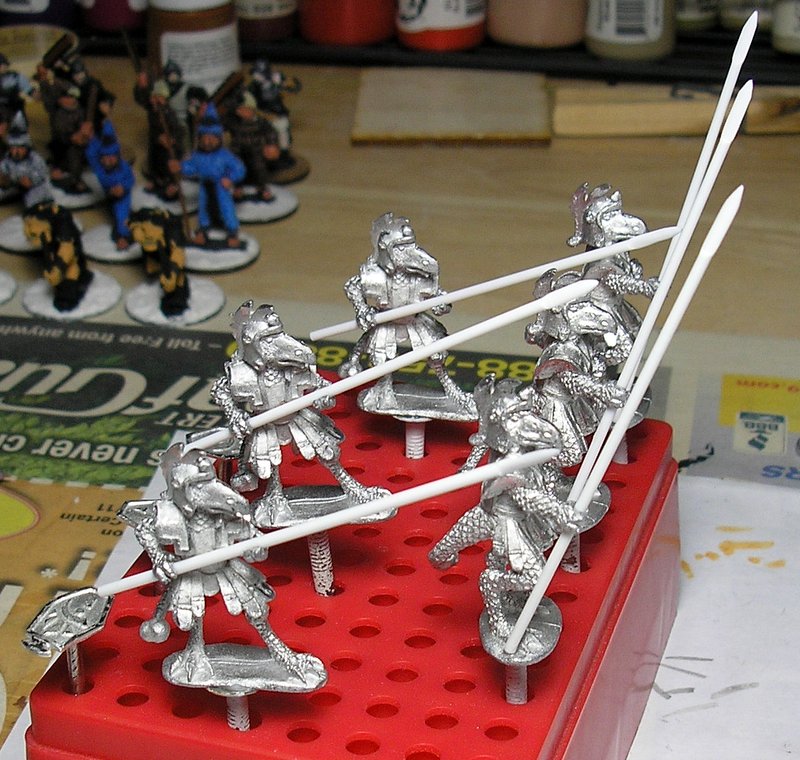
I use plastic rod for my javelins/spears/pikes, with a different diameter for each type.  For pikes I am using 1/16" (1.6mm) rod from my stash of materials that I have hoarded for just such an occasion.  The price tag on this particular material dates back to 1996!


Step 2 of the process:


Pikes for all, with shields for the rear rank, which is the right-most ones in the above pic!  The pikes are approximately 3"/75mm long.  The hands needed to be drilled out, but the material is soft enough and the hands big enough so the chore was not too difficult.


And lastly:


The miniatures now have a coat of black gesso for primer.  I am going to let the gesso dry for a few days before the next step.


.

31 May 2014

Egyptian ship books...

Hmmm, long time no post!  Hopefully, these will help me get back on track:


I was looking for information on the colors of ancient Egyptian ships, and came across these on Amazon.  The book by Sintich is more about making models, and might not have much information on the colors of actual ships, but is very handy as it has plans for making scale ship models.  Besides, it was only $2.28 with free shipping, so I could not pass on it!  The Vinson books just arrived and I have yet to peruse it in depth.


The plan for my Bronze age ships is still as follows:  paint them up as historically plausible as possible, and use them for both historical battles and in my fantasy Tékumel battles.  No one, except the fine readers of this humble blog, will know the difference...


17 May 2014

Tékumel naval, part 12

Another 'for posterity's sake' pic, to remind me of exactly what sort of damage I did to a miniature (!):


This is the Langton Octeres, just prior to having the bow hacked and slashed.  This ship will be receiving the goblin's head, and a new ram...


.

18 January 2014

Tékumel naval, part 11

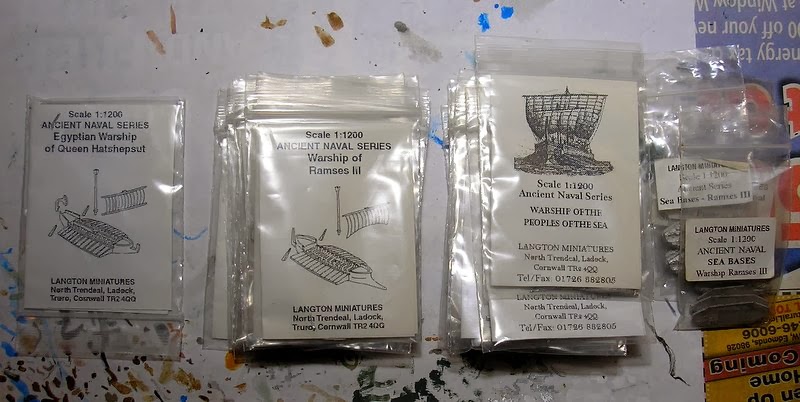
I recently became the proud owner of some new ship miniatures:


More Langton ships, all the way from Down Under courtesy of Ian (who has a fine blog at Thomo's Hole!)  The package included ten Bronze Age Egyptian and ten Sea Peoples ships along with bases.  Of course, what to do with them...  The first course will be to integrate them into my Tékumel fantasy naval project, where, due to their older appearance and small size, they will be representing minor powers (the Tsoléi Islands among others) or perhaps pirates.

And, here are some more detailed pics of the recent purchase:


These miniatures are somewhat smaller than the triremes and such that I have featured earlier.  They might be small enough to be classed as srügánta or even séscha.  These will fit in well with the rest of the collection...


Speaking of the rest, I have been messing about with the Langton Deceres, which I have decided will be a Mu'ugalavyáni zírunel:


I have decided not to graft the goblin's head onto the prow of this vessel, which will grace the Tsolyáni version instead.  The big alteration here, and one that might be extended onto all Red Hat ships, is the replacement of the standard Langton towers, which are shaped more like a cube, with cylindrical alternatives.  The original mast, of white metal, has been replaced with a piece of brass wire with a small bead topping it for a crow's nest.

None of this is glued up yet.  I have yet to decide if this is suitable.  With the similarities of the designs of the miniatures, I am striving to have some differences in the fleets of the various empires beyond the painted finish.  But, are the towers a bit too much???

#Tekumel
.

24 November 2013

Tékumel naval, part 10

Before I start to abuse more miniatures, maybe it would be nice to post some pics of the subjects before undergoing the knife:


This is a Langton deceres, which is destined to become a zírunel


Two pics of a goblin miniature, 15mm in size, that will supply the basis of a new prow for the zírunel.  At first glance, it does look a little large for a 1/1200 ship, but I intend to blend the head into the ship structure somewhat.  Hopefully the conversion will look something close to OK once the knife is set down!

Also up for consideration are a few more add-ons, such as towers, and a decision on nationality - is this a Tsolyáni vessel, or is it Mu'ugalavyáni?  Blue, or red?


.

10 November 2013

Head hunting?

Not much in the mood for painting lately, but I am finding something to occupy myself:


I am in the process of coming up with a plan for my 1/1200 ship miniatures, and the few modifications that I think would be needed to give them a bit of Tékumel flavoring.  If you look at this excellent post at Pagálnikèlikh gàQadóshumashumámrakoi, you will see some artwork that I find very interesting and I intend to shamelessly steal the inspiration for my own!

So, I am digging through some old miniatures, looking for heads and other bitz that I can use.  In the pic, above, you will see several different types of 15mm miniatures, fantasy and historical, that might be useful.  There are some 10mm figures around here as well.  Then, I will need to come up with a plan...


.

02 March 2013

Ahoggyá, part 3

As a small portion of The Plan (see previous post), my lovely wife and I have taken upon ourselves to re-do the little area that my hobby table resided in and expand the capabilities of the room; i.e. we have trashed the place and are re-doing it all including adding her own hobby space!  This of course means that I won't be painting anything for a while...

Fortunately, I snapped a pic of some Ahoggyá progress before they were packed up.

In this pic, one can see the assortment of Ahoggyá arms and armaments:


Quite an assortment.  For my first unit, I am trying to make a rather homogeneous look, rather unlike the Ahoggyá but there you go.


Here are some of the steps in the process:

1.  I have clipped the mace from one left arm, and glued a loose shield in its place.  This will be the left (from this view) rear arm.

2.  This time, I have clipped the entire hand from the mace arm, and the entire hand from a halberd arm.  The halberd arm is unarmored, and in trying to make the entire Ahoggyá armored I thought this would be the easiest way.  Eventually, the halberd hand and mace arm will be drilled out for pinning and glue.  Left forward arm.

3.  Right forward arm - this is the standard sword arm, but I have gently twisted the wrist so the sword will not rest so much in front of the Ahoggyá's front eye set ( can't really say face as they have four!).

4.  Right rear arm - this is the standard axe arm, but I have gently bent the arm at the elbow.


It is going to take some doing, but I find the conversion process fun and hopefully will produce some unique miniatures.


.